The Rats' Procession Out of Bad Blintz
The Amazing Maurice and His Educated RodentsThe Rats' Procession Out of Bad Blintz is the Clan’s organized departure from the town, staged as a spectacle that conceals how deliberately the rats manage their escape. As the crowd cheers Keith and the Rat Piper, rats stream through the streets and appear to plunge into the river. The human spectators think they are watching an entertaining finale; the rats on the bridge are helping their companions make it downstream. The procession turns a public story of rat-piping into a practical operation shaped by the Clan’s cooperation and ingenuity.
From confinement to coordinated release
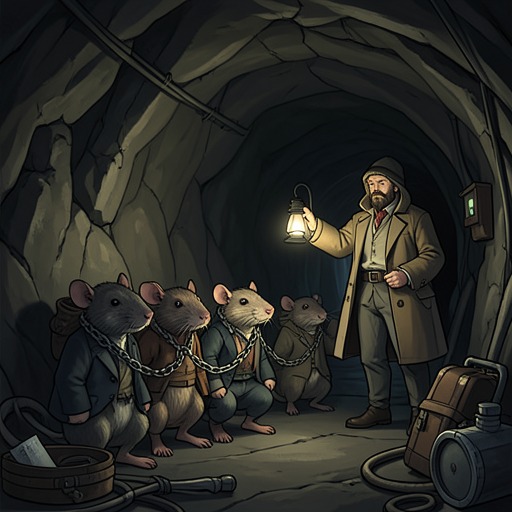
The procession begins in the cage room, where Inbrine makes his way through the tunnels and into the space where the Clan’s rats are held. They unblock their ears when they see him. Darktan learns that the plan is under way and looks towards the cages: the other rats have calmed since the Rat king’s death and have been fed, but they are desperate to leave. He understands that frightened rats may follow one another, and turns that impulse into a means of escape. He orders the runners to open the cages and make sure the rats follow them.
This release follows a story in which fear has repeatedly threatened to break collective action. Earlier, rats running in terror had stopped speaking, a visible sign of how panic could overwhelm the Changed rats’ distinctive ability to think and communicate. Darktan had also explained that a frightened mass of rats might behave as one unthinking animal, rather than as brave individuals. The procession reverses that vulnerability: the rats are not simply swept along by panic but are released under a plan, with runners guiding their movement.
The contrast matters because the Clan’s identity has been built around separation from ordinary rat behaviour. Dangerous Beans describes controlling fire as a way to declare that the rats are not merely rats, but the Clan. Later, Darktan rallies his squad by naming its members as thinking rats who do not simply turn and run. In the cage room, that shared identity becomes practical coordination: the runners have a task, the caged rats have a route to follow, and the urgency to leave is directed rather than left to become a stampede.
A public spectacle
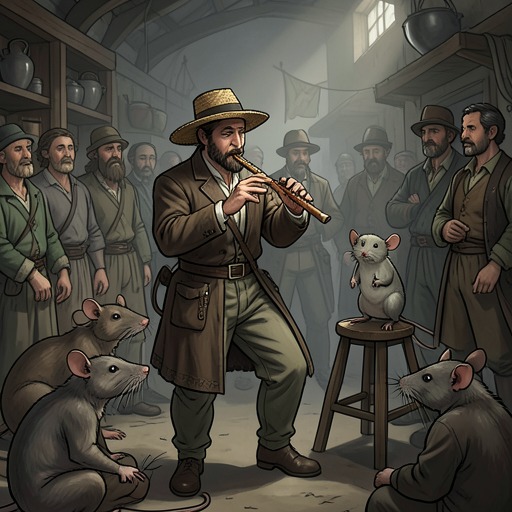
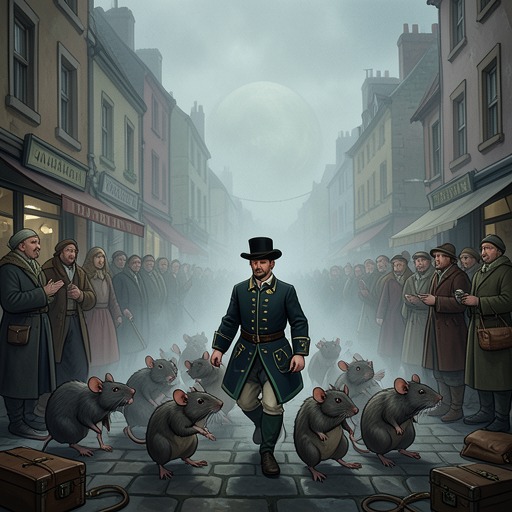
The escape spills into the town in a form the crowd can readily understand. Rats erupt from holes and drains as both pipers dance out of Bad Blintz, with the rats racing behind them. The crowd yells and cheers, then whistles as the rats plunge from the bridge into the river. To the spectators, the procession is a successful show, an exciting ending they can recount to their children. Its visible form invites precisely that interpretation: the pipers lead, the rats follow, and the river seems to provide a dramatic final flourish.
Keith, the young human who has challenged the Rat Piper, is part of this public performance. The spectators applaud him when he strolls back into the square, treating the contest and the rats’ departure as a good day’s entertainment. The scene makes the apparent difference between human and rat understanding part of the event itself: people see a show, while the rats are carrying out an escape whose most important work is easy to miss from the crowd.
What the crowd does not see
Some rats remain on the bridge, calling instructions to those in the water. They urge them to use strong, regular strokes, point out that a beach lies downstream, and advise them to enter the water feet first. These details reveal that the apparent mass plunge is not simply a disastrous end to the procession. The rats on the bridge are helping their companions navigate the river, while the crowd’s attention stays fixed on the spectacle and its supposed conclusion.
The narration makes that gap explicit: the people do not notice the rats’ efforts, and probably would not have remarked on them even if they had. Such practical instructions do not fit the story the audience thinks it has witnessed. The episode therefore lets the reader see two events at once: a celebratory public display and a purposeful operation carried out within it. What looks like disorder from a distance contains local knowledge, guidance, and mutual assistance.
Departure and its significance
The Rat Piper dances away over the hills and never returns. His exit gives the procession a definite ending, but the Clan’s departure is not presented merely as a vanishing act or a victory in a contest. In the larger conflict, the rats have rejected the prospect of being ruled through domination, and Darktan has offered the humans an opportunity to talk rather than an ultimatum to destroy them. The procession carries the Clan out of immediate confinement and danger; it does not, by itself, settle how humans and rats will live together.
The event’s form sharpens that distinction. The humans can turn what they witness into a satisfying story about pipers, cheering, and rats disappearing into the river. The actual escape depends on what the performance hides: the organized release from the cages, the runners’ guidance, and the rats waiting on the bridge to help those in the water. The procession is at once departure and misdirection, showing the Clan acting not as a panicked mass but as a community able to plan, adapt, and look after its own.